
The OP-1 Field represents a significant evolution in portable music creation, building upon the legacy of its predecessor.
Numerous resources, like Synthdawg’s Notebook and SON WU’s YouTube tutorials, supplement the official user manual.
These guides offer deeper insights for both beginners and experienced users exploring its vast capabilities.
Experimentation is key, as the OP-1 Field encourages independent discovery alongside the provided documentation.
Understanding the layout and functions, detailed in available manuals, unlocks the full potential of this innovative instrument.
What is the OP-1 Field?
The OP-1 Field is a portable digital synthesizer, sampler, and recorder, representing Teenage Engineering’s latest iteration in the OP-1 series. It’s designed for musicians, producers, and sound designers seeking a self-contained music creation studio. Unlike traditional instruments, the Field integrates multiple functionalities into a compact, battery-powered device.
The user manual, alongside supplemental resources like Synthdawg’s Notebook, details its core features. It’s more than just a synthesizer; it’s a complete production environment. The Field allows for recording, sequencing, and manipulating audio, offering a unique workflow. It builds upon the original OP-1, addressing user feedback and introducing new capabilities.
The device’s intuitive interface and comprehensive documentation, including the official manual and community-created guides, make it accessible to both beginners and experienced users. It’s a tool for exploration, encouraging experimentation and creative sound design.
Key Features and Capabilities
The OP-1 Field boasts a powerful suite of features detailed within its user manual and expanded upon by resources like Synthdawg’s Notebook. Core capabilities include four independent tracks for drums, bass, chords, and melody, enabling complete song arrangements. It features multiple synthesis engines, offering diverse sonic palettes for sound creation.
Sampling is a key strength, allowing users to record and manipulate external audio sources. Built-in effects – delay, reverb, and more – provide creative sound design options. The Field also functions as a MIDI controller, integrating with other music production setups.
Its sequencing capabilities and synchronization options enhance workflow. The manual highlights these features, while tutorials from creators like SON WU demonstrate practical applications. Ultimately, the OP-1 Field is a versatile instrument for composing, recording, and performing music.
Intended Audience for this Manual
This user manual, alongside supplementary resources like Synthdawg’s Notebook, caters to a broad spectrum of users. It’s designed for newcomers to the OP-1 Field, providing a foundational understanding of its operation and features. However, it also addresses experienced musicians and sound designers seeking to unlock the instrument’s full potential.
Individuals familiar with previous OP-1 iterations will find valuable information on the Field’s enhancements. Those interested in portable music production, sampling, and synthesis will benefit greatly. The manual assumes no prior musical knowledge, but a basic understanding is helpful.
Ultimately, anyone eager to explore creative sound design and composition with the OP-1 Field is the intended audience.

Getting Started with Your OP-1 Field
Initial setup involves unboxing and powering on, referencing the user manual for a quick layout overview.
Familiarize yourself with basic navigation to begin exploring its unique workflow.
Unboxing and Initial Setup
Upon receiving your OP-1 Field, carefully unpack the box, ensuring all components are present. The package typically includes the unit itself, a USB-C cable for charging and data transfer, and potentially some documentation. Before powering on, inspect the device for any physical damage that may have occurred during shipping.
Initial setup is straightforward, but consulting the user manual is recommended for clarity. Connect the USB-C cable to a power source to begin charging the internal battery. While charging, you can also connect the OP-1 Field to your computer to explore initial software updates, if available. The official Teenage Engineering website and resources like Synthdawg’s Notebook provide guidance on this process.
Familiarize yourself with the physical ports and buttons before proceeding. The manual details the function of each control, aiding in a smoother learning curve. Remember to register your OP-1 Field on the Teenage Engineering website for warranty purposes and access to additional support.
Powering On and Basic Navigation
To power on the OP-1 Field, press and hold the power button located on the side of the unit. The screen will illuminate, displaying the main interface. The user manual details the initial boot-up sequence and system checks. Basic navigation relies heavily on the encoder knob and the four directional buttons surrounding it.

The encoder knob allows you to scroll through menus, adjust parameters, and select options. The directional buttons navigate between different screens and functions. Experiment with these controls to become familiar with the interface layout. Resources like SON WU’s YouTube tutorials visually demonstrate these navigation techniques.
Understanding the menu structure, as outlined in the manual, is crucial. The OP-1 Field utilizes a layered menu system, allowing access to various settings and features. Don’t hesitate to explore and experiment – the device is designed to encourage creative discovery!
Understanding the OP-1 Field Layout
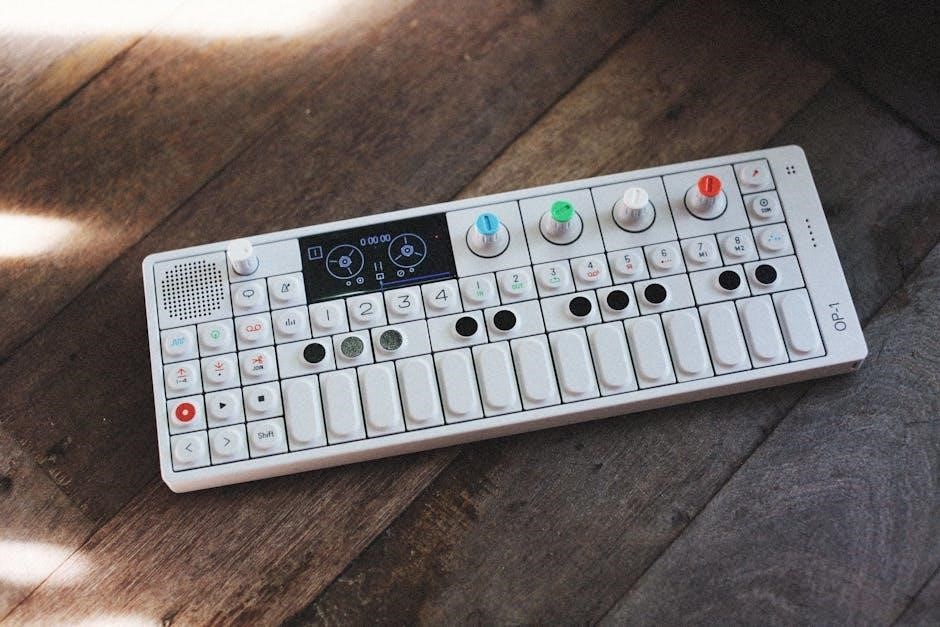
The OP-1 Field’s layout is designed for intuitive operation, though initial familiarity requires referencing the user manual. The central feature is the keyboard, flanked by function buttons controlling various parameters. Above the keyboard, the LCD screen displays information and menus. Synthdawg’s Notebook provides a detailed visual guide to each component.
Key areas include the tape recorder controls, synthesis engine selectors, and effects section. The side panels house the power button, volume control, and connectivity ports. Understanding the placement of these elements streamlines workflow.
The color-coded buttons and clear labeling contribute to ease of use. The included schematic, mentioned in online discussions, aids in quick reference. Don’t be afraid to experiment and map the layout to your creative process!

Core Functionality: The Four Tracks
The OP-1 Field centers around four distinct tracks: Drum, Bass, Chord, and Melody, enabling complete song creation.
The user manual details how to utilize each track for layering sounds and building arrangements.
Mastering these tracks unlocks the instrument’s full compositional potential.
Drum Track: Rhythm and Percussion
The Drum Track on the OP-1 Field is the foundation of your rhythmic creations, offering a versatile platform for crafting beats and percussive elements. The user manual thoroughly explains its functionalities, from selecting pre-loaded drum samples to sequencing intricate patterns. You can explore a diverse range of sounds, layering multiple percussion elements to achieve complex rhythms.
Understanding the track’s sequencer is crucial; it allows for precise control over timing, velocity, and pattern variations. Experiment with different drum kits and sample manipulation techniques to personalize your sound. The manual also details how to utilize the OP-1 Field’s effects to further sculpt the drum track’s sonic character, adding depth and texture to your beats. Mastering this track is essential for building a solid rhythmic base for your musical ideas.
Bass Track: Low-End Foundation
The Bass Track serves as the harmonic and rhythmic bedrock of your compositions on the OP-1 Field. The user manual details how to access and manipulate various bass synthesis engines, ranging from classic analog emulations to more experimental digital tones. You can sculpt powerful low-end frequencies, defining the groove and energy of your tracks.
Explore different waveforms, filter settings, and modulation options to create unique basslines. The sequencer allows for precise control over note placement, rhythm, and dynamics. Utilize the built-in effects to add warmth, distortion, or other sonic textures to your bass sounds. Mastering the Bass Track is vital for establishing a strong and compelling low-end presence in your music.
Chord Track: Harmonic Structure
The Chord Track on the OP-1 Field empowers you to build rich and complex harmonic foundations for your songs. The user manual explains how to utilize various chord progressions and voicings, offering a diverse palette of sonic possibilities. Experiment with different scales, inversions, and chord types to create unique harmonic textures.
The sequencer allows for intricate control over chord changes and rhythmic patterns. Utilize the built-in arpeggiator to generate captivating melodic variations from your chords. Explore the different synthesis engines to shape the tonal character of your harmonic elements. Mastering the Chord Track is essential for crafting emotionally resonant and musically compelling compositions.
Melody Track: Lead Lines and Melodies
The Melody Track is where your musical ideas truly come to life on the OP-1 Field. The user manual details how to craft compelling lead lines and memorable melodies, utilizing the keyboard and sequencer. Explore different scales, modes, and rhythmic variations to express your unique musical voice.
Leverage the various synthesis engines to sculpt the tonal character of your melodic elements, from bright and shimmering leads to warm and intimate textures. Experiment with pitch bend, glide, and other expressive controls to add nuance and emotion; Mastering the Melody Track unlocks the potential for creating captivating and unforgettable musical phrases.

Synthesis Engines
The OP-1 Field’s diverse synthesis engines, detailed in the user manual, offer a wide palette of sonic possibilities.
Explore FM, sampling, and more to create unique sounds.
Exploring the Different Synthesis Modes
The OP-1 Field boasts an impressive array of synthesis modes, each offering a distinct approach to sound design, thoroughly explained within the user manual. From classic digital techniques like FM synthesis – allowing for complex and evolving tones – to granular sampling, which dissects and reconstructs audio, the possibilities are extensive.
Dive into the tape-style workflow to layer and manipulate these sounds. The instrument also features subtractive synthesis, providing a familiar foundation for creating warm, analog-inspired textures. Understanding the nuances of each mode is crucial for unlocking the OP-1 Field’s full sonic potential. Experimentation, guided by the manual, is highly encouraged to discover unique and inspiring sounds.
The user manual will help you navigate these modes effectively;
Parameter Control and Modulation
The OP-1 Field’s intuitive interface allows for deep control over synthesis parameters, as detailed in the user manual. Knobs, buttons, and the touchscreen provide access to a wide range of settings, shaping everything from filter cutoff and resonance to envelope times and LFO rates.
Modulation is central to the OP-1 Field’s expressive capabilities. Utilize the built-in LFOs, envelopes, and step sequencers to create dynamic and evolving sounds. The manual explains how to assign modulation sources to various destinations, adding movement and character to your creations; Explore the tape recorder’s modulation options for further sonic experimentation.
Mastering these controls, guided by the user manual, unlocks a world of sonic possibilities.
Creating Custom Sounds
The OP-1 Field empowers users to craft unique sounds, and the user manual serves as a crucial guide. Explore the diverse synthesis engines – FM, sampling, and virtual analog – each offering distinct sonic palettes. Experiment with parameter adjustments, leveraging modulation sources to introduce dynamic changes.
Dive into the effects section to further sculpt your sounds, utilizing delay, reverb, and other processors. The manual details how to combine these elements to achieve complex textures. Don’t hesitate to experiment; the OP-1 Field thrives on creative exploration.
Synthdawg’s Notebook provides additional insights for advanced sound design techniques.

Effects and Processing
The OP-1 Field’s built-in effects – delay, reverb, and more – are detailed in the user manual. Utilize these creatively for unique sound design possibilities.
Parameter control allows for nuanced sonic shaping.
Built-in Effects: Delay, Reverb, and More
The OP-1 Field boasts a comprehensive suite of built-in effects, meticulously documented within the user manual. These effects are integral to shaping and enhancing your sounds, offering a vast palette for creative exploration. Beyond the staples of delay and reverb, you’ll discover chorus, flange, phaser, and a variety of modulation effects.
Each effect possesses adjustable parameters, allowing for precise control over its character and intensity. The user manual provides detailed explanations of each parameter, guiding you through the process of sculpting your desired sonic textures. Experimentation is strongly encouraged; layering multiple effects can yield surprisingly innovative results.
Understanding the interplay between different effects is crucial. For instance, combining delay with reverb can create spacious, atmospheric soundscapes, while utilizing chorus alongside distortion can add depth and richness to your tones. The OP-1 Field’s effects are not merely add-ons, but powerful tools for transforming your musical ideas.
Utilizing Effects for Creative Sound Design
The OP-1 Field’s effects, as detailed in the user manual, extend far beyond simple enhancement; they are core to innovative sound design. Explore unconventional combinations – a touch of delay on a drum track, or reverb on a bassline – to create unique textures. The manual encourages experimentation, highlighting how layering effects can yield unexpected results.
Modulation effects, like chorus and phaser, can add movement and depth, while distortion introduces harmonic richness. Utilize the effect parameter control to subtly shape sounds or create dramatic transformations. Consider using effects not just on individual tracks, but also on the master output for a cohesive sonic signature.
The user manual serves as a starting point; truly mastering sound design requires pushing boundaries and discovering your own signature techniques with the OP-1 Field.
Effect Parameter Control
The OP-1 Field’s user manual details comprehensive control over each effect’s parameters, allowing for precise sonic sculpting. These parameters, accessible through the interface, govern aspects like delay time, reverb size, distortion amount, and filter cutoff. Mastering these controls is crucial for moving beyond presets and crafting truly unique sounds.
Experiment with subtle adjustments to understand how each parameter impacts the overall tone. The manual emphasizes that even small changes can yield significant results. Utilize the encoders to fine-tune parameters in real-time, creating dynamic and evolving effects.
Don’t hesitate to explore extreme settings – pushing parameters to their limits can uncover unexpected textures and sonic possibilities, as suggested by advanced user manual study.
Sampling and Recording
The OP-1 Field’s user manual guides users through sampling external audio and recording directly into the integrated tape recorder;
Editing samples is intuitive, enabling creative manipulation and integration into compositions.
Explore these features!
Sampling External Audio Sources
The OP-1 Field’s user manual details the process of capturing audio from external sources, expanding its sonic palette beyond its internal synthesis engines. This functionality allows musicians to incorporate real-world sounds, field recordings, or even audio from other instruments directly into their compositions.

The manual explains how to connect external audio devices, adjust input levels, and initiate the sampling process. Users can sample directly from the built-in microphone or utilize the OP-1 Field’s line input for higher-quality recordings. Understanding the nuances of input gain and monitoring is crucial for achieving clean and usable samples.
Furthermore, the user manual guides users on how to trim and manipulate the sampled audio within the OP-1 Field’s interface, preparing it for integration into the four tracks. This feature unlocks a world of creative possibilities, allowing for unique textures and personalized sound design.
Recording and Editing Samples
The OP-1 Field’s user manual comprehensively covers recording and editing sampled audio, a core component of its creative workflow. Once a sample is captured, the manual details how to utilize the tape recorder for non-destructive editing. This allows for experimentation without permanently altering the original source material.
Users learn to manipulate samples through various techniques, including trimming, looping, and time-stretching, all within the intuitive OP-1 Field interface. The user manual explains how to adjust playback speed, reverse samples, and apply basic effects to shape the sound.
Mastering these editing tools is essential for seamlessly integrating samples into compositions. The manual also highlights methods for layering samples, creating complex textures, and utilizing the OP-1 Field’s sequencing capabilities to trigger and arrange sampled material.
Utilizing the Tape Recorder
The OP-1 Field’s user manual dedicates significant attention to the tape recorder, the central hub for arranging and manipulating sounds. It details how to record directly onto the tape, utilizing the four tracks for layering instruments and samples. The manual explains the various tape effects, such as wow and flutter, adding character and warmth to recordings.
Users learn to punch-in and punch-out, allowing for precise editing and overdubbing. The user manual also covers tape lifting and reversing, offering creative possibilities for sound design. Understanding the tape’s limitations, like recording time and signal degradation, is crucial for effective use.
Mastering the tape recorder unlocks the OP-1 Field’s unique workflow, enabling non-linear composition and experimentation.
Advanced Features and Techniques
The OP-1 Field user manual details MIDI control, synchronization with external devices, and sequencing capabilities for experienced users.
Explore deeper functionality beyond basic operation, expanding creative potential with these powerful tools.
Using the OP-1 Field as a MIDI Controller
The OP-1 Field transcends its role as a standalone instrument, functioning effectively as a versatile MIDI controller. The user manual outlines how to connect to computers and other MIDI-compatible devices, unlocking a world of possibilities for integration with Digital Audio Workstations (DAWs) and external synthesizers.
You can control parameters within your DAW, trigger sounds from virtual instruments, and even manipulate effects, all using the OP-1 Field’s intuitive interface. This expands your workflow, allowing for hands-on control and a tactile experience often missing in purely software-based production. The manual details the various MIDI modes and settings, enabling customization to suit your specific needs and preferences.
Experiment with different MIDI mappings to discover unique control schemes and streamline your creative process. The OP-1 Field’s portability combined with its MIDI capabilities makes it an ideal companion for studio and live performance scenarios.
Synchronization and External Devices
The OP-1 Field’s user manual details its synchronization capabilities, allowing seamless integration with other musical equipment. It can act as a clock master or slave, synchronizing tempo with external devices like drum machines, sequencers, and DAWs. This opens up possibilities for complex arrangements and collaborative performances.
Connectivity options, as described in the manual, include MIDI and USB, facilitating communication with a wide range of hardware. Precise timing is crucial for synchronized setups, and the manual provides guidance on configuring these settings for optimal performance. Explore the options for sending and receiving clock signals to create a cohesive musical environment.
Experimentation with different synchronization methods will unlock creative potential, allowing for dynamic interplay between the OP-1 Field and your existing gear.
Utilizing the OP-1 Field’s Sequencing Capabilities
The OP-1 Field user manual comprehensively covers its powerful sequencing features, extending beyond the four tracks. Users can create intricate patterns and arrangements using the built-in sequencer, manipulating notes, velocities, and timing with precision. The manual details how to record, edit, and arrange sequences, offering a flexible workflow for composing music.
Explore the various sequencing modes, including step sequencing and real-time recording, to find the method that best suits your creative process. The manual also explains how to utilize the OP-1 Field’s unique tape recorder functionality in conjunction with sequencing, adding layers of texture and experimentation.
Mastering these capabilities unlocks the full potential of the instrument for creating dynamic and evolving compositions.

Troubleshooting Common Issues
The OP-1 Field user manual guides users through resolving audio, connectivity, and system errors.
Refer to it for solutions to common problems, ensuring a smooth creative workflow.
Don’t hesitate to experiment and explore independently!
Addressing Audio Problems
The OP-1 Field user manual provides initial steps for diagnosing audio issues. Begin by verifying the volume levels on both the device itself and any connected headphones or external speakers. Ensure proper cable connections are secure, and test with alternative cables to rule out a faulty connection.
If experiencing distorted audio, reduce the input gain or output volume. Check the selected synthesis engine and effects, as certain combinations can cause clipping. Explore the manual’s section on signal routing to confirm the audio path is correctly configured.
For complete audio dropout, verify the OP-1 Field isn’t muted and that the correct audio interface is selected in the settings. Consult online resources like Synthdawg’s Notebook or SON WU’s tutorials for more in-depth troubleshooting guidance.
Resolving Connectivity Issues
The OP-1 Field user manual details connection procedures for MIDI and USB devices. If encountering difficulties, first ensure you’re using the correct cable type and that the device is powered on. Verify the OP-1 Field is recognized by your computer’s operating system – check device manager settings.
For MIDI connectivity, confirm proper MIDI channel assignments and that the external device is transmitting and receiving on the correct channels. The manual outlines how to configure these settings within the OP-1 Field.
If USB connectivity fails, try a different USB port or cable. Online resources, such as the OP Forums and YouTube tutorials, often provide solutions for specific connectivity problems.
System Errors and Recovery
The OP-1 Field user manual provides limited information on system error recovery, emphasizing preventative measures like safe shutdown procedures. Should the device freeze or encounter an error, a forced restart is often the first step – holding the power button until it shuts down.
Back up your work frequently, as data loss is possible during system errors. The Synthdawg Notebook and OP Forums offer user-reported solutions for specific error messages.
Teenage Engineering’s support website may have further troubleshooting guidance. If issues persist, contacting their support team directly is recommended. Remember to document the error and steps taken before seeking assistance.